Honeymoon Registry
   

Honeymoon Registry & Romantic Travel Experts

A wedding registry for your honeymoon


Adventure
All-Inclusive
Cruises
Destination Weddings
Villas
 
TheBigDay's most popular travel destinations
 
   
Africa
Aruba
Australia
Bahamas
Belize
Caribbean
Cook Islands
Costa Rica
Fiji
France
Greece
Hawaii
Italy
Jamaica
Maldives
Mexico
New Zealand
Seychelles
St. Lucia
Tahiti
Thailand
Turks and Caicos
Virgin Islands
 
   
  Find a couple's registry

  And your registry could be free!
Most couples at
TheBigDay pay no registry fees.
Learn more
Bridal showers are usually hosted by the maid-of-honor, the bridal party or a close relative. The bride or her mother should not host.
Read more registry advice
Don't over-schedule yourself - some of the best honeymoon memories are unplanned.
Read more travel advice
Hawaii > Travel Guide > Best Time to Visit
  Overview     Recommended Resorts     Travel Guide     Virtual Tours     Advice  

Best Time of Year to Visit Hawaii

Help on using features on this page

Weather on all of the Hawaiian Islands is very consistent, with only minor changes in temperature throughout the year. This is due to year-round warm sea surface temperatures, which keep the overlying atmosphere warm as well. In practical terms, there are only 2 seasons: the summer months (called Kau in Hawaiian) that extend from May to October and the winter months (Ho'oilo) that run from November to April. The average daytime summer temperature at sea level is 85 degrees F. (29.4 C) while the average daytime winter temperature is 78 degrees (25.6 C). Temperatures at night are approximately 10 degrees F lower.

From Hilo City, Mauna Kea is seen reflected in red in the morning sun.
From Hilo City, Mauna Kea is seen reflected in red in the morning sun. Photo courtesy Hawaii Tourism Japan.

The islands are an incredible collection of many diverse micro-environments, each with its own unique weather, plants and animals. As a result of the shielding effect of volcanic mountains and the differences in weather found at various elevations, there are as many different climate zones here as exist along the entire coast stretching from Alaska to Costa Rica. For the full impact of this, visitors need only explore the islands by car or helicopter and they'll see the beauty of tropical rain forests, cool alpine regions, stony deserts and sunny beaches - all within the span of just a few short miles.

Evening view of Kailua Bay.
Photo courtesy Hawaii Tourism Japan.
 

Rainfall and Storms


Through most of the year, Hawaiian weather patterns are affected primarily by high-pressure zones in the north Pacific that pump cool, moist trade winds down onto the island's northeastern slopes. This holds true for most of the summer and approximately half of the time in the winter. These winds are forced up-slope by the mountain heights where their moisture condenses into clouds that produce rain. Most of the rain falls in the mountains and valleys on the windward (northeastern) side of the islands.

It is this weather phenomenon that creates the rich tropical environment for Hawaii's flowers and verdant greens. The wettest months are from November - March, but winter rains do not generally disrupt vacation plans, since the weather is very localized. This means that if it is raining where you are, there is almost always a sunny spot to be found around the coast.

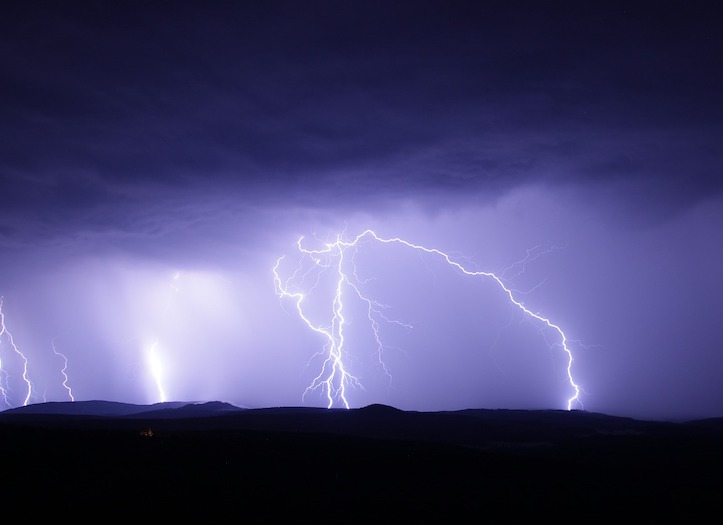
The action of trade winds here means that there is always a cooling breeze. The strength of this wind builds as the heat of the day rises and reaches a peak in the afternoon, only to diminish in the evening and start again the next day. Several times during the year the trade winds will stop completely and the wind will switch around to come out of the south or west, bringing stormy or hot sticky weather. Islanders sometimes call this "Kona" weather, because kona means leeward or South, and this points to the direction from which these weather systems arrive. Stormy weather comes to the islands, primarily in the winter and sometimes lingers for several days. Severe storms, however, are not a common occurrence.

Water and Surf Conditions


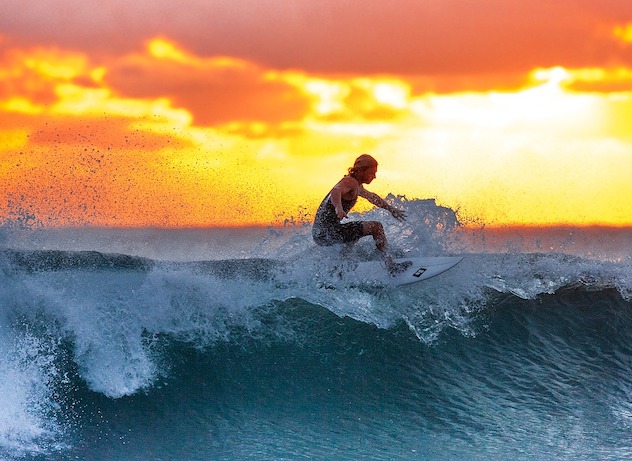
Hawaii's near-shore water temperatures remain comfortable throughout the year. The average water temperature is 74 degrees F. (23.3 C), with a summer high of 80 degrees F. (26.7 C). Wave action varies dramatically between winter and summer, and between island coasts. Summer waters are typically very gentle on all beaches. This changes in the winter on many north-facing beaches, as storms far out into the Pacific drive ocean swells towards the islands, building large breaking waves.

As with island rains, wave conditions are often very localized, so if there is too much surf on your beach, you can usually find calmer water at a more sheltered beach. Strong currents can make any beach unsafe at any time during the year, but this is particularly true in the winter. When in doubt, simply ask your hotel staff or a lifeguard for recommendations and also look for warning flags and posted beach conditions.
  Windsurfing on Maui's north shore. Photo courtesy Ron Dahlquist.

Hawaii's Mountains and Volcanoes

Many visitors are drawn to the natural beauty found in higher elevations such as Kokee on Kauai, or Haleakala on Maui, or Kilauea on the Big Island. To prepare for the trip, bring long pants and several layers of cool weather clothing because the temperature in the higher locations drops 3.5 degrees for every 1,000 feet above sea level that you climb. For example, the summit of Haleakala at an elevation of 10,023 feet can be as much as 30 degrees F. cooler than resort areas on the coast.

Because these peaks rise through the earth's atmosphere, there is less protection from the sun's powerful burning rays. This burning effect can be easily masked by the cool temperatures on the mountain, so be sure to use sun block liberally, and bring a hat and sunglasses.


Information courtesy Hawaii Visitors and Convention Bureau.

« Back to Hawaii Travel Guide
Blog | News Stories | FAQs | Message Boards
About Us | Contact Us | Advertisers | Privacy | Terms of Use | Sitemap

Honeymoon registry questions? Call us at +1 (800) 304-1141
Romantic travel questions? Call us at +1 (866) 867-6759
From outside the USA, please call +1 (503) 245-4093.

Click here to verify our enrollment in the Better Business Bureau   TheBigDay is accredited by IATAN

© Copyright 2001-2009, TheBigDay™ honeymoon registry. All rights reserved.

Server: 10.40.11.114
See TheBigDay's travel guides, photos, videos, maps and recommended resorts for:
Hawaii Honeymoons, Fiji Honeymoons, Tahiti Honeymoons, Caribbean Honeymoons, Cruises, All-Inclusive Resorts and Destination Weddings.